Imagine walking through the gates of a city that was built in a single decade, ruled an empire for 14 years, and then fell silent — frozen in time, almost perfectly preserved. That is Fatehpur Sikri.
Located just 37 kilometres from Agra, Fatehpur Sikri is one of the most extraordinary historical monuments in India. It is a ghost capital. A masterpiece of Mughal architecture. A UNESCO World Heritage Site that most tourists rush through in two hours but genuinely deserves a full half-day.
This guide covers everything — the history, the best monuments to see, how to reach there, what to expect, and how to make the most of your visit. Whether you are a first-time traveller, a history enthusiast, or a photographer looking for that perfect frame, this guide is for you.
Quick Facts About Fatehpur Sikri
What is Fatehpur Sikri? Fatehpur Sikri is a 16th-century walled city built by Mughal Emperor Akbar. It served as the capital of the Mughal Empire from 1571 to 1585 CE. It is located in Agra district, Uttar Pradesh, and is a UNESCO World Heritage Site since 1986.
Slots fill up fast in peak season — secure your verified guide or tour today, one message away on WhatsApp.
💬 Chat on WhatsApp
| Attribute | Details |
|---|---|
| Location | Fatehpur Sikri, Agra District, Uttar Pradesh, India |
| State | Uttar Pradesh |
| Built By | Emperor Akbar |
| Construction Period | 1569–1585 CE |
| Architectural Style | Mughal (blend of Persian, Islamic, and Hindu) |
| UNESCO Status | World Heritage Site since 1986 |
| Famous Structures | Buland Darwaza, Jama Masjid, Tomb of Salim Chishti, Panch Mahal, Diwan-i-Khas |
| Opening Hours | Sunrise to Sunset (approximately 6:00 AM – 6:00 PM) |
| Entry Fee | ₹40 (Indians) / ₹610 (Foreigners) |
| Managed By | Archaeological Survey of India (ASI) |
| Best Time to Visit | October to March |
| Distance from Agra | 37 km |
| Distance from Delhi | 210 km |
What is the History of Fatehpur Sikri?
Short Answer: Fatehpur Sikri was built by Mughal Emperor Akbar in 1569 CE after a Sufi saint named Salim Chishti blessed him with a son. It served as the Mughal capital from 1571 to 1585 and was abandoned shortly after due to water scarcity and military priorities.
Why Did Akbar Build Fatehpur Sikri?
The story of Fatehpur Sikri begins with a desperate prayer.
In the late 1560s, Emperor Akbar — ruler of the most powerful empire in Asia — had everything a king could want. Wealth. An army. Territories stretching from Kabul to Bengal. But he had no male heir. His previous children had died in infancy, and with no prince to succeed him, the future of the Mughal Empire felt uncertain.
A revered Sufi mystic named Shaikh Salim Chishti lived in a small settlement called Sikri, about 37 kilometres west of Agra. Akbar visited the saint, seeking his blessings. Salim Chishti told Akbar that he would have not one, but three sons.
In 1569, Akbar’s eldest wife gave birth to a son. The child was named Salim — in honour of the saint — and would one day rule as Emperor Jahangir. When the second and third sons followed, Akbar’s faith in the saint was total.
In gratitude, Akbar decided to move his capital to Sikri. He commissioned a grand new city to be built on the ridge of rock where Salim Chishti lived. Construction began in 1569. By 1571, Akbar himself shifted to the new city, which he named Fatehpur Sikri — “City of Victory” — to celebrate his military triumph over the Rajput stronghold of Chittorgarh.
Connection with Salim Chishti
Shaikh Salim Chishti (1480–1572 CE) was a Sufi saint belonging to the Chishti order, one of the most respected Sufi lineages in South Asia. He had lived in Sikri for decades before Akbar’s arrival, and his spiritual authority drew disciples from across northern India.
The relationship between Akbar and Salim Chishti was more than devotional — it was deeply personal. Akbar placed the saint’s dargah at the very heart of the Jama Masjid complex. When Salim Chishti died in 1572, Akbar built a magnificent white marble tomb in his honour. That tomb stands to this day, gleaming among the red sandstone buildings, and remains an active site of pilgrimage.
Thousands of devotees visit the Tomb of Salim Chishti every year. They tie threads on the marble lattice screens, believing that prayers made here are answered — just as Akbar’s prayer was answered centuries ago.
Fatehpur Sikri as the Mughal Capital
When Akbar moved his court to Fatehpur Sikri in 1571, he was not just building a home — he was building a statement.
The city became the political, cultural, and intellectual hub of the Mughal Empire. Akbar held court here. He debated theology here — his famous Ibadat Khana (House of Worship) was where scholars from Islam, Hinduism, Jainism, Zoroastrianism, and even Jesuit Christianity gathered to discuss religion. He administered justice here from the Diwan-i-Aam. He received ambassadors from Persia, Central Asia, and Europe.
At its peak, Fatehpur Sikri housed thousands of residents — soldiers, nobles, merchants, scholars, craftsmen, and their families. It was a living, breathing city.
Why Was Fatehpur Sikri Abandoned?
Short Answer: Fatehpur Sikri was abandoned primarily due to an inadequate water supply that could not support the growing population of the city. Some historians also point to Akbar’s military campaigns in the northwest, which required him to relocate his capital to Lahore in 1585.
Detailed Explanation
This is one of the most debated questions in Indian history, and the real answer is probably a combination of several factors.
1. Water Scarcity The most widely accepted explanation is that Fatehpur Sikri simply ran out of water. The city was built on a rocky ridge with no major river nearby. The reservoirs and wells that supplied the city struggled to meet the needs of its growing population. Prolonged droughts may have made the situation worse.
2. Military Strategy In 1585, Akbar launched a major military campaign to consolidate the northwestern frontier — particularly against threats from the Uzbeks and to manage the situation in Kabul and Kashmir. This required him to move his court closer to the action, and he shifted his base to Lahore. He never returned to Fatehpur Sikri.
3. Trade Route Shifts Some historians suggest that shifts in trade routes reduced the economic importance of the Sikri location, making Agra and Lahore more strategically valuable.
What makes Fatehpur Sikri extraordinary is that the city was not destroyed. It was simply… left. The buildings were not demolished or looted (at least not entirely). They were locked up and abandoned. As a result, much of the original city survived intact — which is why it feels so eerily complete today.
Did You Know? Fatehpur Sikri served as the Mughal capital for only about 14 years — from 1571 to 1585 CE. Yet the buildings constructed during this brief period represent some of the finest examples of Mughal architecture in existence.
UNESCO Recognition
Fatehpur Sikri was designated a UNESCO World Heritage Site in 1986.
UNESCO recognised it as an outstanding example of Mughal architecture at its zenith — a unique blend of Persian, Islamic, and Hindu design traditions. The site is maintained by the Archaeological Survey of India (ASI), which is responsible for its conservation, visitor management, and ongoing restoration work.
Why is Fatehpur Sikri Famous?
Fatehpur Sikri is famous for several reasons:
- It is one of the best-preserved examples of Mughal urban planning in the world.
- It contains the Buland Darwaza, one of the largest gateways in the world, standing 54 metres tall.
- The Tomb of Salim Chishti is a masterpiece of white marble craftsmanship.
- The complex represents Akbar’s unique philosophy of sulh-i-kul (universal peace and tolerance), reflected in an architecture that blends Hindu, Persian, and Islamic elements.
- It is a UNESCO World Heritage Site and a protected monument of national importance.
- Unlike most ruins, Fatehpur Sikri is remarkably complete — you can walk through palaces, courtyards, mosques, and pavilions and actually imagine life as it was 450 years ago.
Top Places to Visit in Fatehpur Sikri
The complex of Fatehpur Sikri is divided broadly into two zones: the religious complex (centred around the Jama Masjid) and the royal palace complex (the administrative and residential quarters). Both are remarkable.
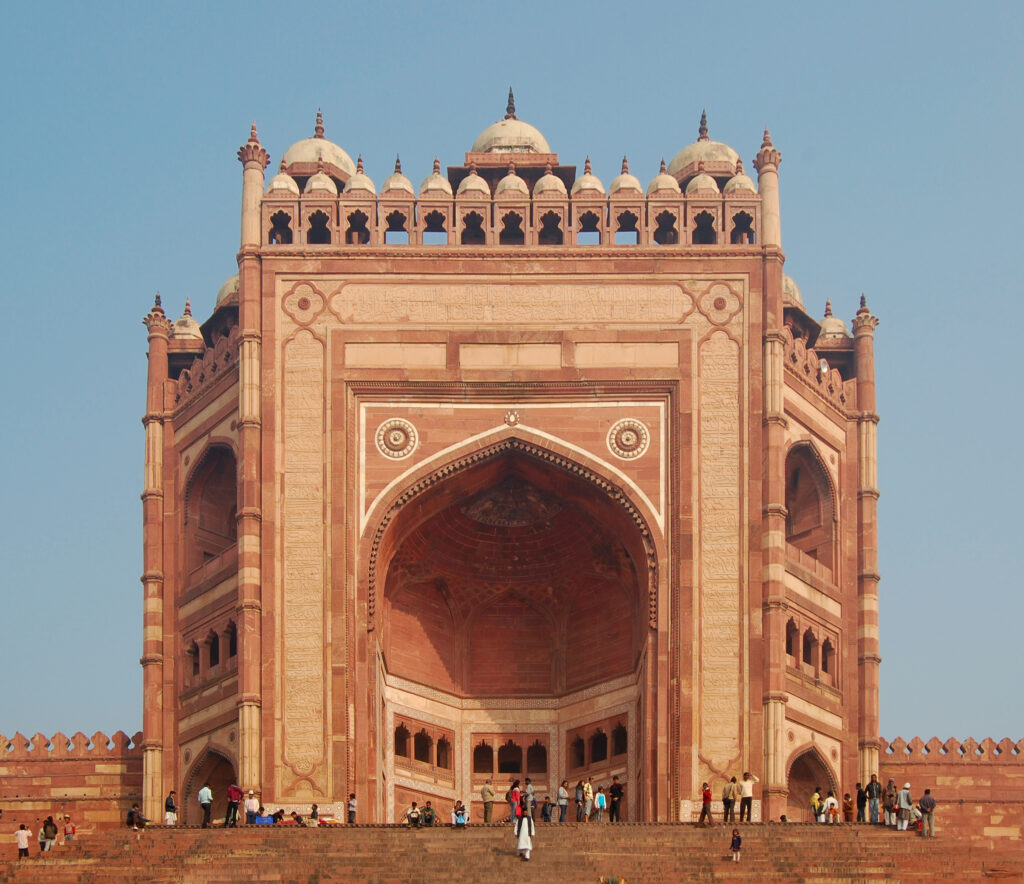
1. Buland Darwaza
The Buland Darwaza is the main entrance to the Jama Masjid at Fatehpur Sikri and is one of the largest gateways in the world.
Built in 1576 CE by Emperor Akbar to commemorate his victory over Gujarat, the Buland Darwaza (meaning “Gate of Magnificence”) rises 54 metres above the ground and 42 metres above the courtyard floor. You approach it by climbing 52 steps — and the climb alone is worth it for the view.
The gateway is built in red and buff sandstone, inlaid with white and black marble. A Persian inscription on the arch reads: “The world is a bridge — pass over it, but build no house on it.” This quote is often attributed to Jesus (Isa) and reflects Akbar’s inclusive spiritual worldview.
Visitor Tip: Climb to the top of the steps early in the morning for the best light and the most dramatic view of the courtyard below.
2. Jama Masjid (Dargah Mosque)
The Jama Masjid at Fatehpur Sikri is one of the largest mosques in India, built between 1571 and 1572 CE.
Also known as the Dargah Mosque, it was constructed as a congregational mosque for the royal court and the citizens of the new capital. The courtyard of the mosque can accommodate thousands of worshippers.
The mosque is built in red sandstone and follows a traditional Persian-Islamic plan — a large rectangular courtyard surrounded by colonnaded halls on three sides, with the main prayer hall (qibla) on the west. The architecture is beautiful in its simplicity and scale.
Note: Non-Muslim visitors are welcome but must remove their shoes and dress modestly. Women may be offered a headscarf at the entrance.
3. Tomb of Salim Chishti
The Tomb of Salim Chishti is a white marble mausoleum built by Emperor Akbar in 1572 CE to honour the Sufi saint who blessed him with an heir.
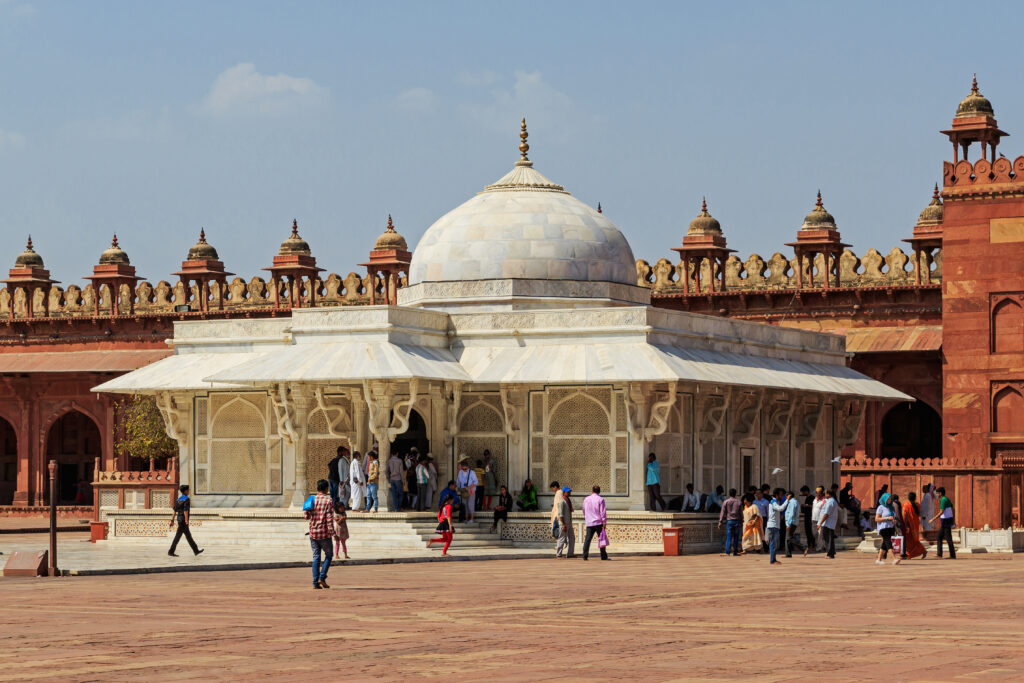
This is arguably the most stunning structure inside the Jama Masjid complex. While most of Fatehpur Sikri is built in deep red sandstone, the Tomb of Salim Chishti gleams in pure white marble — creating a striking visual contrast.
The tomb is famous for its jali screens — intricate geometric latticework carved out of single slabs of marble. The craftsmanship is extraordinary. Light filters through the patterns, creating shadow-plays inside the chamber that change throughout the day.
Devotees of all religions visit the tomb to tie red and green threads (called mannat threads) on the jali screens, praying for wishes to be fulfilled. The practice continues today, exactly as it did in Akbar’s time.
Expert Tip: Visit the Tomb of Salim Chishti in the late afternoon when the light turns golden. The white marble catches the warm sunset light beautifully — and photographically, it is unforgettable.
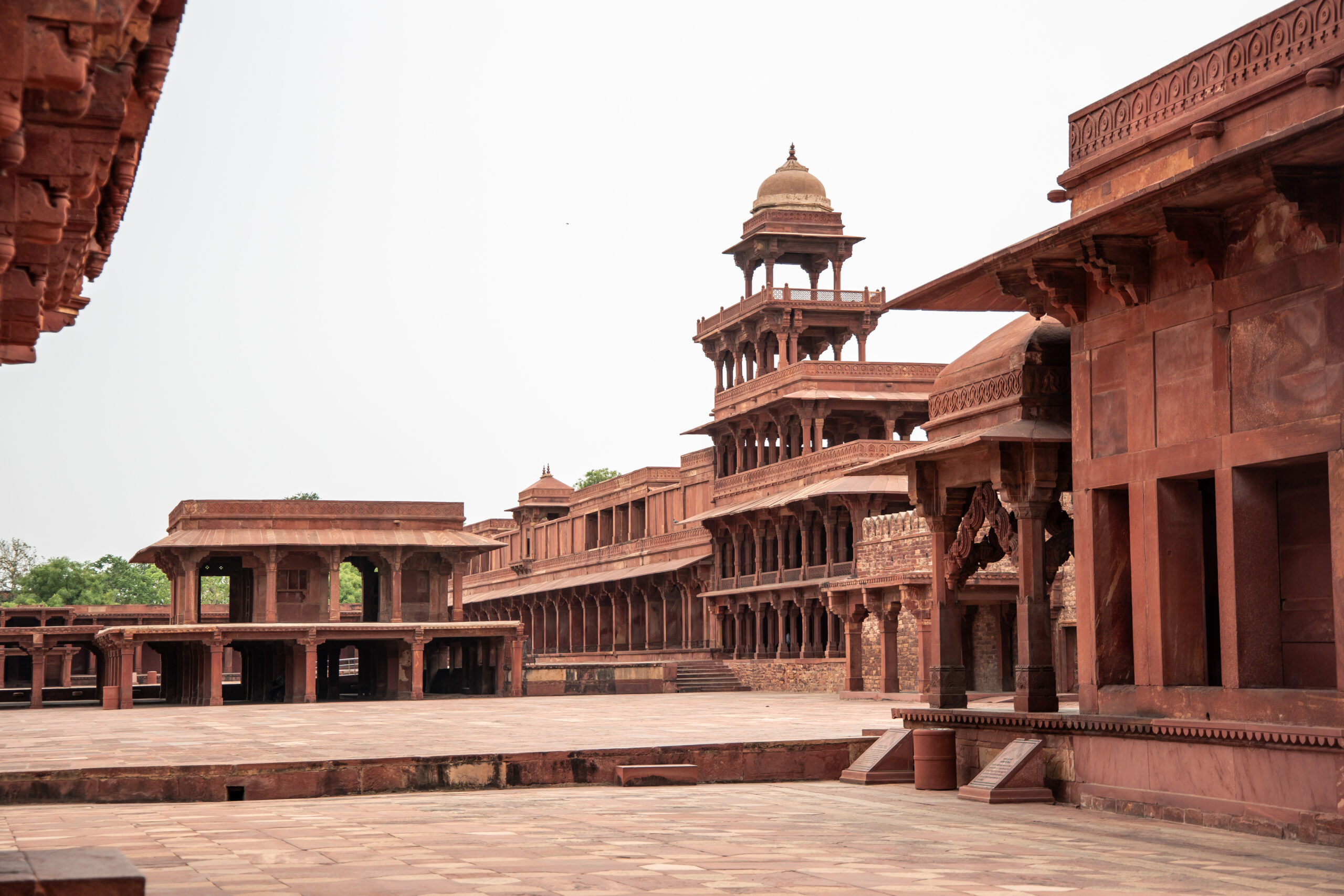
4. Panch Mahal
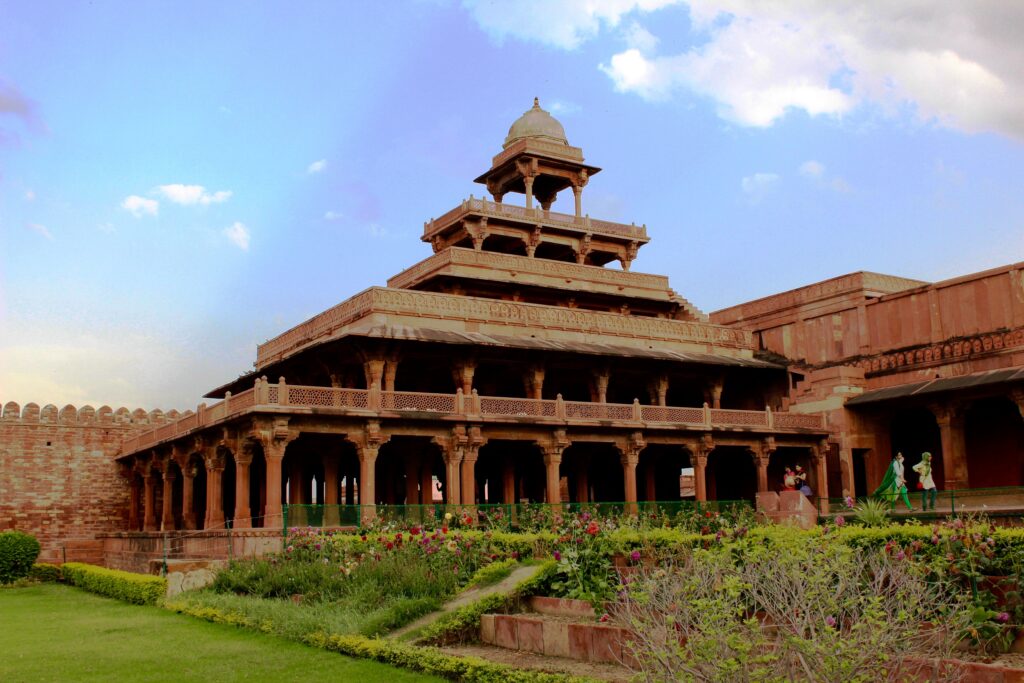
The Panch Mahal is a five-storey pavilion at Fatehpur Sikri, built in a style that draws heavily from Buddhist temple architecture.
The name literally means “Five-Storey Palace.” It is an open, columned structure — each floor smaller than the one below it — that was used by the women of the royal household as a pleasure pavilion. The top floor is a single chamber supported by a single column.
What makes the Panch Mahal visually striking is that each of its 176 columns is unique — carved with different designs, some Hindu, some Islamic, some seemingly decorative. This eclecticism is quintessentially Akbari.
The views from the upper floors — though you cannot climb to the very top — are lovely, with the entire royal enclosure spread out below.
5. Diwan-i-Khas (Hall of Private Audience)
The Diwan-i-Khas is the hall where Emperor Akbar held private meetings with advisors, nobles, and foreign ambassadors.
From the outside, it looks like a two-storey building. Step inside, and you realise it is actually a single large chamber with a remarkable centrepiece: a massive stone column supporting a circular platform at the top, connected to four corner galleries by narrow diagonal walkways.
This is the famous throne platform where Akbar supposedly sat — elevated above everyone else, with advisors positioned below him on four sides. The symbolism is clear: the emperor at the centre, hearing all views, above all factions.
Some scholars call it one of the most inventive interior architectural spaces produced in Mughal India. It is small, but it is stunning.
6. Diwan-i-Aam (Hall of Public Audience)
The Diwan-i-Aam was where Emperor Akbar held public court and heard the grievances of common citizens.
This is a large open courtyard with a colonnaded arcade on three sides and a raised platform on the fourth — the emperor’s seat, from which he would address the public. The design is both functional and theatrical: the platform ensured that Akbar could be seen from a distance, making the act of imperial justice visible.
The Diwan-i-Aam is one of the first structures you encounter after entering the royal enclosure, and it sets the tone for everything that follows.
7. Anup Talao (Peerless Pool)
Anup Talao is a decorative pool located in the centre of the royal enclosure at Fatehpur Sikri, surrounded by walkways and a central platform.
The name means “Peerless Pool” or “Incomparable Pond.” The pool has a square platform in the centre connected to the sides by four narrow bridges. It is believed that Akbar and his court musicians — including the legendary singer Tansen — would perform here, with the water amplifying the acoustics.
Tansen was one of the Navaratnas (Nine Gems) of Akbar’s court — nine extraordinary scholars, artists, and advisors who served the emperor. The Anup Talao is one of the more atmospheric spots in the complex, especially early in the morning.
8. Jodha Bai Palace (Mariam-uz-Zamani Palace)
Jodha Bai Palace is the largest residential palace within the Fatehpur Sikri complex, believed to have been the residence of Akbar’s chief wife.
There is some historical debate about which queen this palace actually belonged to — some historians believe it was the residence of Mariam-uz-Zamani (popularly known as Jodha Bai). Regardless of attribution, it is the grandest domestic building in the complex.
The palace blends Hindu and Islamic architectural elements in a way that reflects Akbar’s religious pluralism: Hindu carved brackets and temple-style columns alongside Islamic arched doorways. The main courtyard is large and peaceful, with several rooms arranged around it.
Did You Know? Akbar had multiple wives from different religious backgrounds — Rajput, Persian, and Afghan. His court was a model of cultural diversity that was remarkable even by modern standards.
9. Birbal’s House
Birbal’s House is believed to be the residence of Birbal, one of the Navaratnas and Akbar’s closest advisor and court jester.
Birbal — also known as Raja Birbal — is one of the most beloved figures in Indian historical folklore. He was famous for his wit, wisdom, and his extraordinary relationship with Akbar. The stories of Akbar-Birbal remain popular across India even today.
His house at Fatehpur Sikri is a beautifully decorated two-storey structure with intricate carvings. Some historians actually believe it served as the residence of one of Akbar’s wives rather than Birbal, but the popular name has stuck.
10. Turkish Sultana House (Anup Talao Pavilion)
The Turkish Sultana House is a small but elaborately decorated pavilion near Anup Talao, covered in exquisite stone carvings from floor to ceiling.
Despite its name, historians are not entirely sure this building had any connection with a Turkish queen. What is undisputed is that it is one of the most ornately decorated structures in the entire Fatehpur Sikri complex.
Every surface — walls, ceilings, columns, brackets — is carved with intricate floral and geometric patterns. There are no empty spaces. It is a celebration of craftsmanship in stone. Do not rush past this one.
Fatehpur Sikri Architecture Explained
Fatehpur Sikri represents the mature phase of Mughal architecture — a confident, experimental blend of Persian, Central Asian, Islamic, and Hindu architectural traditions.
Unlike later Mughal monuments like the Taj Mahal (which is predominantly Islamic-Persian in style), Fatehpur Sikri is deliberately eclectic. Akbar was a curious, open-minded emperor who drew from every tradition he encountered.
Key architectural features:
- Material: Almost entirely built in local red sandstone (not marble, with the exception of the Tomb of Salim Chishti). The stone was quarried from the Sikri ridge itself, giving the buildings their distinctive warm colour.
- Structural System: Mostly post-and-lintel construction (influenced by Hindu temple architecture) rather than the arch-and-dome system dominant in Islamic architecture. This is unusual for a Mughal complex.
- Ornamentation: Carvings range from purely geometric Islamic patterns to Hindu floral motifs, animals (elephants, peacocks), and even kirtimukhas (Hindu decorative faces).
- Spatial Planning: The complex is laid out on a ridge with careful attention to visual hierarchy — important buildings occupy elevated positions or prominent axes.
- Jali Screens: Pierced stone screens appear throughout the complex, particularly in the Tomb of Salim Chishti, creating lace-like patterns of light and shadow.
The architecture of Fatehpur Sikri is, in a sense, Akbar’s philosophy made physical — a synthesis of diverse traditions into something new and distinctly Indian.
How to Reach Fatehpur Sikri
From Agra
Fatehpur Sikri is 37 km from Agra and is the most logical starting point for visitors.
By Road: The road from Agra (via NH-21) is well-maintained and takes approximately 45–60 minutes by car or taxi. Shared buses and local transport are also available from Agra’s Idgah Bus Stand.
By Train: A few passenger trains connect Agra to Fatehpur Sikri, but they are slow and infrequent. Road travel is generally recommended.
Private Taxi: This is the most convenient option. A private taxi from Agra costs approximately ₹1,200–₹1,800 for a round trip including waiting time. Most tour operators include Fatehpur Sikri in their Agra day packages — this is often the most cost-effective option.
Internal Link Opportunity: If you are planning a combined visit, consider an Agra Fatehpur Sikri Tour or a Same Day Agra Tour By Car — both typically include Taj Mahal, Agra Fort, and Fatehpur Sikri in a single day.
From Delhi
Delhi to Fatehpur Sikri is approximately 210 km via the Yamuna Expressway, which takes around 3–3.5 hours by car.
By Train: Take a fast train from Delhi to Agra (Bhopal Shatabdi or Gatiman Express — approximately 1.5–2 hours), then hire a cab from Agra to Fatehpur Sikri.
By Road: If you are driving from Delhi, take the Yamuna Expressway to Agra, then continue on NH-21 towards Fatehpur Sikri.
Delhi-based travellers often combine this with a Golden Triangle Tour covering Delhi, Agra, and Jaipur — Fatehpur Sikri fits naturally into the Agra leg.
Distance Chart
| Origin | Distance | Approx Travel Time (By Road) |
|---|---|---|
| Agra | 37 km | 45–60 minutes |
| Jaipur | 199 km | 3.5 hours |
| Delhi | 210 km | 3–3.5 hours |
| Mathura | 72 km | 1.5 hours |
| Bharatpur | 23 km | 30 minutes |
| Lucknow | 350 km | 5–6 hours |
Fatehpur Sikri Timings and Entry Fee
| Detail | Information |
|---|---|
| Opening Hours | Sunrise to Sunset (approx. 6:00 AM – 6:00 PM) |
| Days Open | All days of the week |
| ASI Ticket Price (Indian Citizens) | ₹40 per person |
| ASI Ticket Price (Foreign Nationals) | ₹610 per person |
| Children Under 15 | Free (for SAARC and BIMSTEC nationals) |
| Jama Masjid / Tomb of Salim Chishti | No ASI ticket required (separate entry, donation-based) |
Important: The ticket for the royal palace complex (Diwan-i-Aam, Panch Mahal, Diwan-i-Khas, etc.) is a separate entry from the Jama Masjid / mosque complex. You can visit the Jama Masjid and Tomb of Salim Chishti without an ASI ticket, though donations are expected.
Visitor Tip: The Composite Ticket (₹510 for foreigners) covers Taj Mahal, Agra Fort, Fatehpur Sikri, and other ASI monuments across Agra and can be very good value if you plan to visit multiple sites.
Best Time to Visit Fatehpur Sikri
The best time to visit Fatehpur Sikri is from October to March, when temperatures are pleasant and the site is easy to explore on foot.
| Season | Months | Conditions | Recommendation |
|---|---|---|---|
| Best (Winter) | October – March | 10°C – 25°C, cool and dry | Ideal. Comfortable for walking, great photography light. |
| Acceptable (Monsoon) | July – September | 25°C – 35°C, humid, occasional rain | The complex is green and atmospheric. Manageable with an umbrella. |
| Avoid (Summer) | April – June | 35°C – 45°C, extremely hot | The red sandstone reflects heat intensely. Very uncomfortable midday. |
Best time of day: Early morning (7:00 AM – 9:00 AM) for soft golden light, fewer crowds, and cooler temperatures. The site also looks spectacular in the late afternoon just before sunset.
How Much Time is Needed to Explore Fatehpur Sikri?
Short Answer: A thorough visit to Fatehpur Sikri takes 2.5 to 3.5 hours. If you include the Jama Masjid and Tomb of Salim Chishti, plan for a minimum of 3 hours.
| Type of Visit | Recommended Time |
|---|---|
| Quick / Highlights Only | 1.5 – 2 hours |
| Standard Visit (both complexes) | 3 – 3.5 hours |
| Detailed / Photography / History | 4 – 5 hours |
Most tourists underestimate the size of Fatehpur Sikri and rush through it. Give yourself at least 3 hours to do it justice.
Fatehpur Sikri Walking Route
Suggested Walking Route (Approx. 3 Hours)
Start at the Buland Darwaza — enter through the main gateway and pause to read the inscription.
↓
Jama Masjid courtyard — take in the scale. Walk slowly through the arcades.
↓
Tomb of Salim Chishti — spend time admiring the jali screens. Observe the rituals.
↓
Exit the mosque complex, walk to the ASI ticketing area. Buy your ticket for the royal enclosure.
↓
Diwan-i-Aam — understand the public court layout.
↓
Diwan-i-Khas — study the central column and throne platform.
↓
Anup Talao — pause and imagine Tansen performing here.
↓
Turkish Sultana House — don’t rush. Look at every wall.
↓
Panch Mahal — climb as high as permitted and look out over the complex.
↓
Jodha Bai Palace — walk through the residential quarters. Notice the blended Hindu-Islamic details.
↓
Birbal’s House — view from outside and walk through the carved chambers.
↓
Exit via the main road, browse the market stalls (marble crafts are the best buy here).
Fatehpur Sikri Travel Tips
Visitor Checklist
- ✅ Carry plenty of water — there are limited drinking water points inside.
- ✅ Wear comfortable walking shoes with good grip (the sandstone ramps can be slippery).
- ✅ Carry a scarf or dupatta — required to enter the mosque area.
- ✅ Hire an ASI-licensed guide at the gate for a significantly richer experience.
- ✅ Keep small change ready for donations at the dargah.
- ✅ Start early — before 9 AM if possible.
- ✅ Download an offline map (Google Maps works well offline here).
- ✅ Buy an Archaeological Survey of India guidebook at the ticket counter.
- ✅ Carry sunscreen and a hat for summer or shoulder-season visits.
Practical Tips for Foreign Tourists
- A licensed guide at Fatehpur Sikri typically charges ₹500–₹800 for a 2-hour tour in English. It is strongly recommended — the stories and context transform the experience.
- Taxis and auto-rickshaws wait outside the main entrance to take you back to Agra. Agree on the price before you get in.
- There are basic food stalls and shops outside the main entrance. Avoid eating inside the complex.
- ATMs are not available inside the complex. Carry cash.
- Photography is permitted in the royal enclosure. The Tomb of Salim Chishti permits photography but be respectful.
Tips for Families with Children
- The Panch Mahal is a favourite with children — they love climbing up the levels.
- The Buland Darwaza steps are steep. Hold young children’s hands.
- The open courtyards are pram-friendly.
- Plan for a maximum of 2 hours if travelling with young children — it gets tiring.
- The market outside the complex sells marble inlay souvenirs — excellent quality and a fraction of what you pay in Agra city.
Common Tourist Mistakes to Avoid
- Rushing through in 1 hour. Fatehpur Sikri deserves at least 3 hours. Rushing is the single biggest regret of visitors here.
- Skipping the Jama Masjid. Many tourists head straight to the ticketed royal palace complex and miss the mosque entirely — including the Tomb of Salim Chishti, which is one of the most beautiful structures on the site.
- Not hiring a guide. The buildings without context are beautiful but somewhat cryptic. A good guide tells you who lived where, what happened in each hall, and why certain architectural choices were made.
- Coming in the midday summer heat. April–June midday temperatures can hit 43°C. If you visit in summer, arrive by 7:30 AM and leave by 10:30 AM.
- Carrying too much cash. Be aware of persistent vendors and unofficial “guides” near the entrance who may follow you and demand payment. Politely decline anyone without an ASI badge.
- Forgetting to look up. Seriously. The ceilings, brackets, and upper portions of the walls are often where the finest carvings are.
- Leaving no time for the market. The shops outside Fatehpur Sikri sell beautiful marble inlay work (pietra dura), similar to what you see in the Taj Mahal. The quality is high and prices are more reasonable than in Agra city.
Fatehpur Sikri for Photography Lovers
Fatehpur Sikri is one of the most photogenic heritage sites in India. Here is how to make the most of it photographically:
Golden Hour: Arrive at 7:00 AM. The red sandstone glows brilliantly in early morning light. Shadows are long and dramatic.
Best Shots:
- Buland Darwaza from the base of the steps (use a wide-angle lens).
- Tomb of Salim Chishti at golden hour — the white marble against the pink sky is extraordinary.
- Looking up through the jali screens of the Tomb for intricate shadow patterns.
- Panch Mahal from the Anup Talao side for depth and scale.
- Diwan-i-Khas central column — shoot from a low angle looking up.
- The long colonnaded corridors of the Jama Masjid for geometry and perspective.
Equipment Tip: A wide-angle lens (16–24mm equivalent) is most useful here. The spaces are large, and you will want to capture context. A polarising filter helps manage the strong midday light on white marble.
Drone Photography: Not permitted. ASI does not allow drones at ticketed heritage monuments without prior permission.
Places to Visit Near Fatehpur Sikri
| Place | Distance | What To See |
|---|---|---|
| Agra (Taj Mahal) | 37 km | The most iconic monument in India |
| Agra Fort | 40 km | Mughal fort, also a UNESCO site |
| Bharatpur Bird Sanctuary (Keoladeo NP) | 23 km | UNESCO World Heritage bird sanctuary |
| Mathura & Vrindavan | 72 km | Birthplace of Lord Krishna, major pilgrimage circuit |
| Khanwa | 15 km | Battle site of historical significance |
Can You Visit Taj Mahal and Fatehpur Sikri in One Day?
Short Answer: Yes, you can visit both the Taj Mahal and Fatehpur Sikri in one day, though it requires an early start and good time management.
Suggested One-Day Itinerary (From Agra):
| Time | Activity |
|---|---|
| 6:00 AM | Taj Mahal (arrive at sunrise opening) |
| 8:30 AM | Return to hotel, breakfast |
| 9:30 AM | Depart for Fatehpur Sikri |
| 10:30 AM | Arrive at Fatehpur Sikri, start with Jama Masjid |
| 1:30 PM | Complete Fatehpur Sikri, lunch at a nearby restaurant |
| 3:00 PM | Agra Fort (optional) |
| 5:30 PM | Return to hotel or depart for Delhi/Jaipur |
A pre-planned Same Day Agra Tour By Car or Taj Mahal Sunrise Tour can handle all the logistics, making this combination stress-free.
This itinerary works best from October to March. In summer, consider skipping the afternoon Agra Fort visit.
Fatehpur Sikri vs Agra Fort: A Quick Comparison
| Feature | Fatehpur Sikri | Agra Fort |
|---|---|---|
| Type | Abandoned city / palace complex | Functioning fort / palace |
| Built By | Emperor Akbar | Originally Lodi dynasty; rebuilt by Akbar |
| Architecture | Experimental Mughal-Hindu-Persian | Classical Mughal |
| UNESCO Status | Yes (1986) | Yes (1983) |
| Main Attraction | Buland Darwaza, Tomb of Salim Chishti | Diwan-i-Khas, Musamman Burj, Jahangiri Mahal |
| Crowds | Moderate | Heavy |
| Time Required | 3–4 hours | 2–3 hours |
| Photography | Excellent (more open, fewer crowds) | Good (some restrictions) |
| Recommended For | History, architecture, photography | Mughal history, views of Taj Mahal |
Both sites are excellent and complement each other well. If you have one day in Agra and must choose, the Taj Mahal is non-negotiable, but Fatehpur Sikri is a stronger second choice than Agra Fort for visitors who care about architecture and history.
Interesting Facts About Fatehpur Sikri
- Fatehpur Sikri served as the capital of the Mughal Empire for approximately 14 years, from 1571 to 1585 CE.
- The name “Fatehpur” means “City of Victory” — named to celebrate Akbar’s conquest of Gujarat.
- The Buland Darwaza was built in 1576 CE and stands 54 metres high — it is one of the tallest gateways in Asia.
- Akbar’s famous “Navaratnas” (Nine Gems) — his nine extraordinary courtiers — included Birbal, Tansen, Abul Fazl, Todar Mal, and others. Most of them lived and worked at Fatehpur Sikri.
- The Tomb of Salim Chishti is one of the finest examples of Mughal marble craftsmanship anywhere — predating the Taj Mahal by nearly 70 years.
- The Ibadat Khana (House of Worship) at Fatehpur Sikri was one of the world’s earliest examples of interfaith dialogue — scholars of multiple religions gathered here to debate theology under Akbar’s encouragement.
- Fatehpur Sikri has approximately 60 structures within its walls, spread over an area of 6 km².
- The red sandstone of Fatehpur Sikri came from the same quarries that supplied material for the Agra Fort — both were built around the same time.
- American architect Frank Lloyd Wright reportedly called Fatehpur Sikri one of the world’s most remarkable urban ensembles.
- Today, a small town has grown up around the historical complex, and approximately 30,000 people live within the original city walls.
Myths and Facts About Fatehpur Sikri
| Myth | Fact |
|---|---|
| Fatehpur Sikri was abandoned because of a curse | There is no historical evidence for this. The most supported reasons are water scarcity and military redeployment. |
| Jodha Bai was Akbar’s wife | The historical figure “Jodha Bai” is debated. Her actual name may have been Hira Kunwari or Mariam-uz-Zamani. |
| The Tomb of Salim Chishti grants wishes | This is a matter of faith, not historical record. But the practice of tying threads and making wishes has continued for over 400 years. |
| Birbal’s House was Birbal’s actual home | Many historians now believe this building served as a women’s residence, not Birbal’s home. |
| The city was abandoned in a single day | In reality, the abandonment was gradual — Akbar moved to Lahore in 1585, but the city was not locked up overnight. |
| Fatehpur Sikri is a lesser site than Agra | This is a common misconception. The site is architecturally more diverse and historically more significant than many give it credit for. |
Frequently Asked Questions (FAQs)
General Questions
Q1. What is Fatehpur Sikri?
Fatehpur Sikri is a 16th-century walled city and UNESCO World Heritage Site located 37 km from Agra, Uttar Pradesh. Built by Emperor Akbar between 1569 and 1585 CE, it served as the capital of the Mughal Empire for about 14 years before being abandoned. It contains outstanding examples of Mughal architecture including the Buland Darwaza, Jama Masjid, and the Tomb of Salim Chishti.
Q2. Where is Fatehpur Sikri located?
Fatehpur Sikri is located in the Agra district of Uttar Pradesh, India. It sits on a rocky ridge 37 km west of Agra city, accessible via NH-21. It is approximately 210 km from Delhi and 199 km from Jaipur.
Q3. Who built Fatehpur Sikri?
Fatehpur Sikri was built by Mughal Emperor Akbar, the third Mughal Emperor of India. Construction began in 1569 CE after a Sufi saint named Salim Chishti blessed Akbar with a male heir. The city was completed and inaugurated as the Mughal capital in 1571 CE.
Q4. Why is Fatehpur Sikri a UNESCO World Heritage Site?
Fatehpur Sikri was inscribed as a UNESCO World Heritage Site in 1986 because it represents an outstanding example of Mughal architecture and urban planning. UNESCO recognised it as a unique synthesis of Persian, Islamic, and Hindu architectural traditions and a remarkably well-preserved example of a 16th-century royal city.
Q5. Is Fatehpur Sikri worth visiting?
Absolutely. Fatehpur Sikri is one of the most underrated heritage sites in India. It is better preserved than most Mughal monuments, less crowded than Agra’s main sites, architecturally richer in its diversity, and historically fascinating. If you are visiting Agra, skipping Fatehpur Sikri would be a significant mistake.
Timings, Entry & Tickets
Q6. What are the opening hours of Fatehpur Sikri?
Fatehpur Sikri is open from sunrise to sunset, approximately 6:00 AM to 6:00 PM, seven days a week. The Jama Masjid complex (including the Tomb of Salim Chishti) has no fixed closing time as it is a functioning place of worship, but the royal palace complex follows ASI timings strictly.
Q7. What is the entry fee for Fatehpur Sikri in 2026?
The entry fee for the ASI-managed royal palace complex is ₹40 for Indian citizens and ₹610 for foreign nationals. Children under 15 from SAARC and BIMSTEC countries enter free. The Jama Masjid and Tomb of Salim Chishti are free to enter (though donations are accepted).
Q8. Is there a combined ticket for Agra monuments?
Yes. The Archaeological Survey of India offers a composite ticket that covers multiple Agra monuments including the Taj Mahal, Agra Fort, and Fatehpur Sikri. For foreign nationals this is priced at ₹510 and is valid for 2 days from the time of first use.
Q9. Can I visit Fatehpur Sikri without a guide?
Yes, but it is not recommended. Many structures lack detailed English signage, and without context, the history and significance of what you are seeing is easily missed. ASI-licensed guides charge approximately ₹500–₹800 for a guided tour in English and are available at the main entrance.
History and Architecture
Q10. Why was Fatehpur Sikri abandoned?
Fatehpur Sikri was abandoned primarily because of an inadequate water supply that could not sustain the growing population of the city. Additionally, Akbar’s military campaigns on the northwestern frontier required him to shift his base to Lahore in 1585. He never returned to Fatehpur Sikri, and the city was gradually evacuated.
Q11. How long was Fatehpur Sikri the capital of the Mughal Empire?
Fatehpur Sikri served as the capital of the Mughal Empire for approximately 14 years, from 1571 to 1585 CE. Despite this relatively brief period, it remains one of the finest examples of Mughal-era urban planning and architecture in existence.
Q12. What is the Buland Darwaza?
The Buland Darwaza (Gate of Magnificence) is the main southern entrance to the Jama Masjid at Fatehpur Sikri. Built in 1576 CE by Emperor Akbar to commemorate his victory over Gujarat, it stands 54 metres high and 42 metres above the mosque courtyard floor. It is one of the tallest and most impressive gateways in Asia.
Q13. Who was Salim Chishti?
Shaikh Salim Chishti (1480–1572 CE) was a Sufi saint of the Chishti order who lived at Sikri. He blessed Emperor Akbar with a prophecy of male heirs — which came true. In gratitude, Akbar built his capital at Sikri and constructed a magnificent white marble tomb for the saint, which remains an active place of pilgrimage to this day.
Q14. What architectural styles are present at Fatehpur Sikri?
Fatehpur Sikri blends Persian, Islamic, and Hindu architectural traditions. Key features include post-and-lintel construction (influenced by Hindu temple architecture), red sandstone as the primary material, intricate jali (lattice screen) carvings, Islamic arches and domes, Hindu corbelled brackets, and floral and geometric ornamentation from multiple traditions.
Q15. What are the Navaratnas and are they connected to Fatehpur Sikri?
The Navaratnas were Akbar’s nine legendary courtiers — exceptional scholars, artists, and administrators who served the emperor. They included Birbal (advisor and wit), Tansen (musician), Abul Fazl (historian), Todar Mal (finance minister), and others. Most of them lived and worked at Fatehpur Sikri during Akbar’s reign there.
Planning Your Visit
Q16. How much time is needed to explore Fatehpur Sikri?
A thorough visit to Fatehpur Sikri takes 3 to 3.5 hours if you explore both the Jama Masjid complex and the royal palace complex. Photography enthusiasts and history buffs may want 4–5 hours. Most tourists allocate only 1–2 hours, which is insufficient to appreciate the site properly.
Q17. What is the best time to visit Fatehpur Sikri?
The best time to visit Fatehpur Sikri is from October to March, when temperatures range from 10°C to 25°C, making it comfortable to walk around the large complex. Within the day, early morning (7:00 AM – 9:00 AM) offers the best light for photography and the fewest crowds.
Q18. Can I visit Fatehpur Sikri and Taj Mahal in one day?
Yes. Many visitors combine both sites in a single day by starting at the Taj Mahal at sunrise (6:00 AM), then driving to Fatehpur Sikri by mid-morning. With good time management, you can comfortably visit both. Adding Agra Fort to the same day is possible but makes for a long and tiring day.
Q19. How do I get from Agra to Fatehpur Sikri?
The most convenient way is by private taxi, which costs approximately ₹1,200–₹1,800 for a round trip with waiting time. Shared buses and autos are also available from Agra’s Idgah Bus Stand. The 37 km journey takes 45–60 minutes by road.
Q20. Is Fatehpur Sikri safe for solo female travellers?
Fatehpur Sikri is generally safe for solo female travellers. The site has ASI security personnel and is well-managed. Dress modestly, wear covered shoes, and carry a scarf for the mosque areas. Like any tourist site in India, be aware of persistent touts and unofficial guides near the entrance, and exercise normal urban caution.
Q21. Are there restaurants or cafes inside Fatehpur Sikri?
There are no restaurants inside the complex itself. There are basic food stalls and shops in the market area just outside the main entrance. For a proper meal, you will need to return to Agra or eat at one of the restaurants along the NH-21 highway.
Q22. Can I buy souvenirs at Fatehpur Sikri?
Yes. The market area outside the entrance has numerous shops selling marble inlay work (pietra dura), miniature paintings, textiles, and other handicrafts. The marble inlay work here is particularly good quality and more reasonably priced than in central Agra. Bargaining is expected.
Q23. Is there parking available at Fatehpur Sikri?
Yes. There is a large car and bus parking area near the main entrance. A small parking fee is charged. If you are arriving by taxi, the driver will drop you at the entrance and wait in the parking area.
Q24. Are there any restrictions on photography inside Fatehpur Sikri?
Photography for personal use is permitted throughout the complex, including inside the royal enclosure and at the Tomb of Salim Chishti (be respectful at the tomb). Commercial photography requires ASI permission. Drone photography is not permitted without prior official clearance.
Q25. Is Fatehpur Sikri accessible for visitors with mobility issues?
The complex presents some challenges for visitors with mobility issues. The Buland Darwaza is approached by 52 steps. The royal enclosure has uneven stone surfaces and ramps. However, much of the site at ground level is navigable. Wheelchairs are not officially available at the site (as of 2025), so plan accordingly.
Q26. What should I wear to visit Fatehpur Sikri?
Wear comfortable, breathable clothing and sturdy walking shoes. Carry a scarf or shawl to cover your head when entering the Jama Masjid and the Tomb of Salim Chishti. Avoid sleeveless tops or shorts out of respect for the religious space. In summer, light cotton clothing and a hat are essential.
Q27. Are audio guides available at Fatehpur Sikri?
ASI does provide audio guide devices at some major heritage sites, but availability varies. Check at the ticket counter on arrival. Alternatively, several apps (including the ASI heritage app) offer audio content for Fatehpur Sikri.
Q28. Is the Bharatpur Bird Sanctuary near Fatehpur Sikri?
Yes. The Keoladeo National Park (Bharatpur Bird Sanctuary), a UNESCO World Heritage Site and one of Asia’s finest bird sanctuaries, is only 23 km from Fatehpur Sikri. If you are a nature enthusiast, combining the two sites in a single day is very feasible — especially between November and February when migratory birds are present.
Conclusion: Key Takeaways
Fatehpur Sikri is not just a stop on the way to Agra. It is a destination in its own right — one of the most extraordinary historical sites in India and, arguably, in the world.
Key Takeaways
- Fatehpur Sikri was built by Emperor Akbar between 1569 and 1585 CE and served as the Mughal capital for 14 years.
- It is a UNESCO World Heritage Site, recognised in 1986 for its outstanding Mughal architecture.
- The most important structures include the Buland Darwaza, Jama Masjid, Tomb of Salim Chishti, Panch Mahal, Diwan-i-Khas, and Jodha Bai Palace.
- Entry to the royal palace complex costs ₹40 (Indians) / ₹610 (foreigners). The Jama Masjid is free.
- The best time to visit is October to March. Come early — by 7:30 AM if possible.
- Plan at least 3 hours. Hire a licensed guide. Bring water. Wear comfortable shoes.
- Fatehpur Sikri can be combined with the Taj Mahal in a single day from Agra.
- The site is 37 km from Agra and 210 km from Delhi.
What stays with you after visiting Fatehpur Sikri is not just the grandeur of the buildings, but the strange, melancholy feeling of a city frozen in time. The courtyards where an emperor held court are empty and silent. The halls where Tansen sang are still. The pool where the greatest minds of the 16th century debated theology now reflects clouds.
But the stone remembers. And if you slow down, look carefully, and listen to a good guide, Fatehpur Sikri will tell you stories that no textbook ever quite captures.
Go. It is worth every minute.
This article has been written to provide accurate, up-to-date travel information for visitors planning a trip to Fatehpur Sikri. All historical details are based on verified sources including ASI records, UNESCO documentation, and established historical scholarship. Entry fees and timings are accurate as of early 2026 but may be subject to change — always confirm with ASI or your tour operator before visiting.
Related Articles You’ll Love
- Taj Nature Walk in Agra: Hidden Taj Mahal Views and a Peaceful Sunrise Experience
- Things to Know Before Visiting India (2026 First-Time Guide)
- Taj Mahal Dress Code & Rules for Foreign Tourists
- Mehtab Bagh Agra: Complete Visitor Guide
- Taj Mahal Banned Items: What NOT to Bring Inside — Complete 2026 Guide
- How to Photograph the Taj Mahal Like a Pro — Best Angles and Lighting Tips
- 15 Best Tourist Places Near New Delhi Railway Station