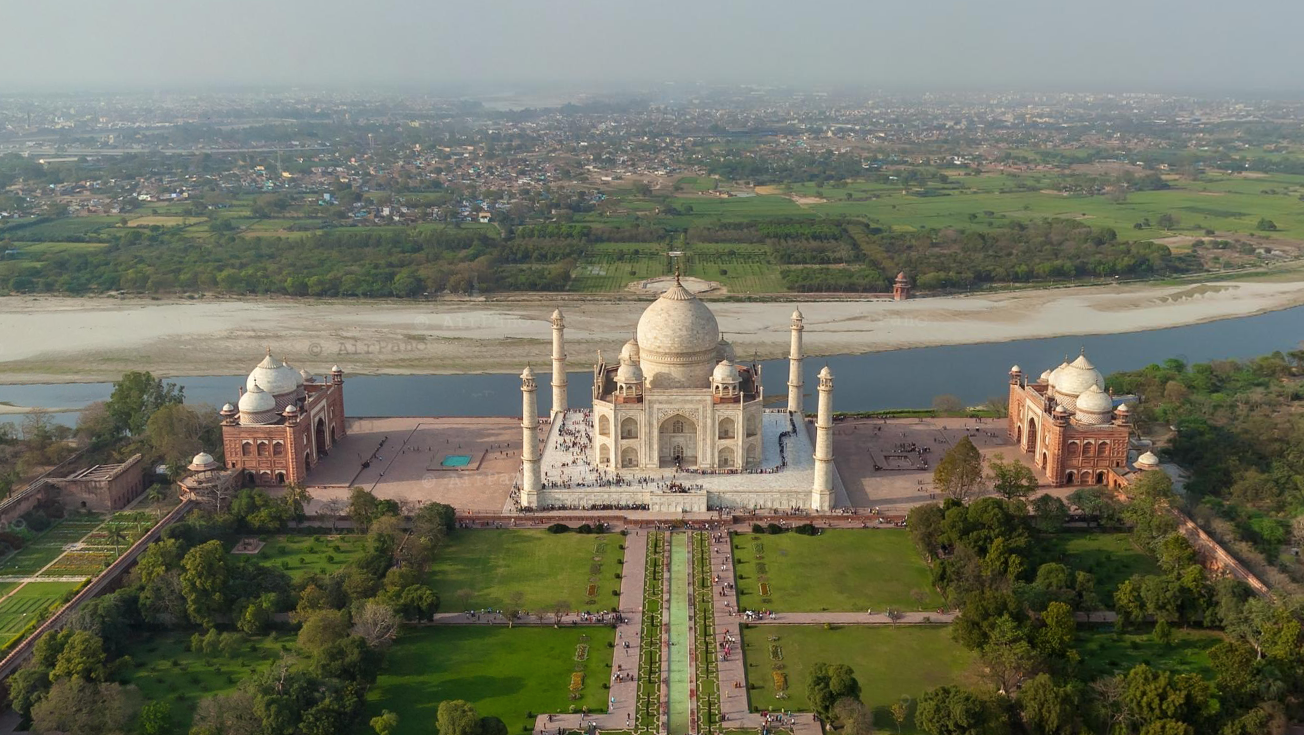
The Taj Mahal stands on the southern bank of the Yamuna River in Agra, India — a city that draws millions of visitors every year because of this single monument. Commissioned by Mughal Emperor Shah Jahan in memory of his beloved wife Mumtaz Mahal, the Taj Mahal is widely regarded as one of the finest examples of Mughal architecture ever built. Its gleaming white marble dome, its perfectly balanced gardens, and the deeply personal love story behind its creation have made it one of India’s most recognizable landmarks and a symbol of devotion admired across the world. But beyond the postcard-perfect exterior, the Taj Mahal holds layers of history, craftsmanship, and design details that most visitors never hear about. Here are ten fascinating Taj Mahal facts that might surprise you.
1. The Taj Mahal Was Built in Memory of Mumtaz Mahal
The story behind the Taj Mahal is inseparable from the story of Shah Jahan and Mumtaz Mahal. Born Arjumand Banu Begum, Mumtaz Mahal married Shah Jahan in 1612 and became his closest companion and most trusted confidante. She accompanied him on military campaigns, advised him on matters of state, and bore him fourteen children. When she died in 1631 during the birth of their fourteenth child in Burhanpur, Shah Jahan was reportedly inconsolable. He resolved to build a mausoleum so magnificent that it would stand as an eternal tribute to her memory. That decision gave the world the Taj Mahal — a monument born not from political ambition but from personal grief.
2. The Taj Mahal Took Many Years to Complete
Construction of the Taj Mahal began in 1632, roughly a year after Mumtaz Mahal’s death. The main mausoleum — the iconic domed structure at the heart of the complex — was substantially completed by around 1648. However, the broader complex, including the gardens, gateways, mosque, guest house, and surrounding infrastructure, continued to take shape until approximately 1653. The extended timeline reflects the sheer scale of the project: quarrying and transporting marble, executing thousands of intricate inlay panels, laying out the formal gardens, and engineering the water channels all demanded years of sustained effort by a vast workforce.
3. The Taj Mahal Is Famous for Its White Marble
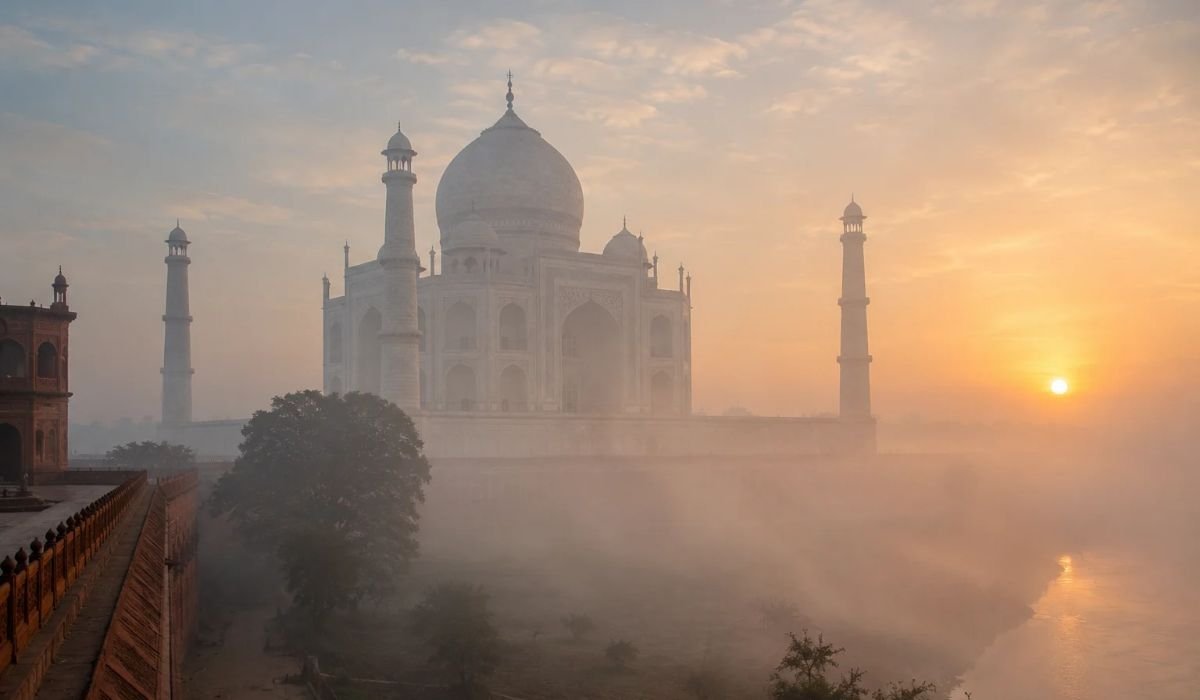
One of the most striking facts about the Taj Mahal in Agra is the material that defines its appearance. The mausoleum is clad in white Makrana marble, a high-quality stone quarried from Rajasthan. This marble gives the Taj Mahal its luminous quality — it appears to change colour subtly throughout the day, glowing pinkish at dawn, brilliant white at noon, and golden under moonlight. Beyond the stone itself, the surface is not left plain. Artisans polished the marble to a smooth sheen, then carved delicate floral reliefs directly into its surface. Combined with the elaborate stone inlay work (discussed below), the marble transforms the Taj Mahal from a building into something closer to a sculptural masterpiece.
4. The Taj Mahal Is Designed Around Symmetry
Symmetry is central to Mughal architectural philosophy, and the Taj Mahal is one of its most disciplined expressions. The mausoleum sits on a raised marble platform at the northern end of a long, formal garden divided into four quadrants by water channels — a layout inspired by the concept of a Paradise garden. To the west of the mausoleum stands a red sandstone mosque; to the east stands the Jawab, a mirror-image structure built purely for visual balance. Even the minarets at the four corners of the platform are identical in height and placement. This commitment to geometric harmony gives the complex a sense of calm and order that visitors feel immediately, even before they understand the mathematics behind it.
5. Shah Jahan’s Tomb Breaks the Perfect Symmetry
Here is one of the lesser-known facts about the Taj Mahal that catches many visitors off guard. Inside the main chamber, Mumtaz Mahal’s cenotaph sits precisely at the geometric centre of the interior — aligned perfectly with the building’s axis. Shah Jahan’s cenotaph, however, sits beside hers, slightly offset to the west. Shah Jahan was not originally intended to be buried here; after his death in 1666, his son Aurangzeb had him interred alongside Mumtaz Mahal. The addition of his cenotaph introduced one of the few noticeable asymmetrical elements in the entire complex — a small but significant disruption to a building otherwise defined by perfect balance.
6. The Tombs Tourists See Are Cenotaphs
Many visitors assume the ornate marble structures inside the main chamber are the actual graves of Shah Jahan and Mumtaz Mahal. They are not. These are cenotaphs — decorative memorial markers placed at the main floor level for visitors to see. The real burial sites are located in a quieter, simpler lower chamber directly beneath the cenotaphs. This arrangement follows a tradition in Islamic funerary architecture, where the actual graves are kept at or below ground level while a more elaborately decorated cenotaph occupies a prominent position above. Knowing this adds an extra layer of meaning to a visit: the beauty on display upstairs is a tribute; the resting place below is private and restrained.
7. The Taj Mahal Features Intricate Stone Inlay Work
The decorative surfaces of the Taj Mahal showcase a technique known as parchin kari (often compared to the Italian pietra dura tradition). Artisans cut thin slices of semi-precious and precious stones — including carnelian, jasper, lapis lazuli, turquoise, and onyx — into precise shapes, then fitted them into shallow cavities carved into the white marble. The resulting patterns include flowering plants, vines, and abstract floral motifs, many so finely executed that a single flower can contain dozens of individually cut stone pieces. This Taj Mahal architecture fact often astonishes visitors who lean in for a closer look: what appears from a distance to be painted decoration is actually a mosaic of coloured stone, flush with the marble surface and still vivid after nearly four centuries.
8. Skilled Artisans Worked on the Taj Mahal
The Taj Mahal was not built by unskilled labour alone. It required a vast team of specialists: stone cutters who shaped the marble blocks, carvers who executed floral reliefs and geometric borders, calligraphers who rendered Quranic verses in flowing script across the gateways and tomb facades, masons who assembled the structural core, inlay artists who performed the painstaking parchin kari work, and painters who decorated interior surfaces. Historical accounts indicate that artisans were drawn from across the Mughal Empire and beyond — including craftsmen from Central Asia, Persia, and other parts of the Indian subcontinent. While exact workforce numbers are difficult to verify and vary across sources, the diversity and specialisation of the labour involved is well documented.
9. Ustad Ahmad Lahori Is Widely Recognised as the Principal Architect
The question of who designed the Taj Mahal does not have a single, simple answer. Ustad Ahmad Lahori is the name most commonly associated with the overall architectural plan, and several historical sources support his role as the principal architect. However, a project of this scale was never the product of one mind. A large team of architects, structural engineers, garden designers, and master craftsmen contributed to the design and execution. This collaborative approach to grand construction was a hallmark of Mughal-era projects, much like the building of Fatehpur Sikri nearby. The calligraphy, for example, is attributed to Amanat Khan, whose signature appears on the gateway. Recognising this collaborative effort is important — the Taj Mahal is a monument shaped by many hands and many disciplines working together over decades.
10. The Taj Mahal Became a UNESCO World Heritage Site in 1983
In 1983, UNESCO inscribed the Taj Mahal on its World Heritage List, recognising it as a masterpiece of human creative achievement. The designation highlights the monument’s outstanding architectural and artistic value, its historical significance as a Mughal imperial commission, and its enduring influence on art and culture worldwide. UNESCO recognition has also reinforced conservation efforts, drawing global attention to the challenges of preserving the monument against pollution, environmental wear, and the pressures of mass tourism. Today, the Taj Mahal remains one of the most visited UNESCO World Heritage Sites on the planet.
Why Is the Taj Mahal So Special?
The Taj Mahal’s reputation rests on a combination of qualities that few other monuments can match. Architecturally, it represents the pinnacle of Mughal design — a tradition that blended Persian, Islamic, and Indian building styles into something distinct and refined. The white Makrana marble, polished and carved with extraordinary precision, gives the structure an almost otherworldly glow. Its geometric planning is rigorous: every gateway, garden path, water channel, and minaret serves both an aesthetic and a spatial function, contributing to the complex’s sense of harmony. The calligraphy inscribed across its facades — rendered in black marble inlaid into white — adds a layer of spiritual meaning. The parchin kari inlay work transforms flat surfaces into fields of delicate floral art. And the Charbagh garden layout, with its symmetrical quadrants and reflective pools, frames the mausoleum in a setting designed to evoke paradise.
But what elevates the Taj Mahal beyond pure architecture is the story it embodies. It is, at its core, a monument to love and loss — and that emotional resonance connects with visitors from every culture and background. For anyone planning a trip to Agra, understanding these layers of meaning makes the experience far richer than simply photographing a beautiful building.
Interesting Taj Mahal Facts at a Glance
- Location: Agra, Uttar Pradesh, India
- Builder: Mughal Emperor Shah Jahan
- Construction started: 1632
- Main mausoleum completion: Approximately 1648
- Wider complex completion: Approximately 1653
- Architectural style: Mughal architecture (blending Persian, Islamic, and Indian elements)
- Main material: White Makrana marble
- UNESCO status: World Heritage Site since 1983
- Famous for: Symmetry, marble craftsmanship, stone inlay work, and the love story behind its creation
- City: Agra
Frequently Asked Questions About the Taj Mahal
Who built the Taj Mahal?
The Taj Mahal was commissioned by Mughal Emperor Shah Jahan in memory of his wife, Mumtaz Mahal.
Why was the Taj Mahal built?
Shah Jahan ordered the construction of the Taj Mahal as a mausoleum to honour Mumtaz Mahal after her death in 1631.
When was the Taj Mahal built?
Construction began in 1632. The main mausoleum was substantially completed by around 1648, and the wider complex was finished by approximately 1653.
How long did the Taj Mahal take to build?
The main mausoleum took roughly sixteen years, and the entire complex took over two decades to complete.
Who designed the Taj Mahal?
Ustad Ahmad Lahori is widely recognised as the principal architect, though a large team of architects, engineers, and craftsmen contributed to the design and construction.
Where are Shah Jahan and Mumtaz Mahal actually buried?
Their actual graves are in a lower burial chamber beneath the main floor. The ornate structures visitors see at the main level are cenotaphs — decorative memorials, not the actual burial sites.
Why is the Taj Mahal famous?
The Taj Mahal is famous for its white marble architecture, symmetrical design, intricate stone inlay work, and the love story behind its creation.
Is the Taj Mahal a UNESCO World Heritage Site?
Yes. The Taj Mahal was inscribed as a UNESCO World Heritage Site in 1983.
What is unique about Taj Mahal architecture?
Its combination of Mughal, Persian, and Indian architectural traditions, its precise symmetry, its marble cladding, its parchin kari stone inlay, and its Charbagh garden layout make it architecturally distinctive.
What is the best time to visit the Taj Mahal?
October to March is generally considered the best period, when temperatures in Agra are cooler and more comfortable for sightseeing. Early morning visits offer softer light and smaller crowds. Read our detailed guide on the best time to visit the Taj Mahal to plan your trip better.
Conclusion
The Taj Mahal is far more than a beautiful building. It is a convergence of architectural mastery, artistic detail, historical significance, and human emotion — qualities that have kept it at the centre of global admiration for nearly four hundred years. These interesting facts about the Taj Mahal only scratch the surface of what this monument has to offer. The symmetry, the stone inlay, the story of Shah Jahan and Mumtaz Mahal — all of it comes alive when you stand in front of the real thing. If Agra is on your travel list, make the time to visit. Explore the top places to visit in Agra beyond the Taj Mahal, and discover what makes this city unforgettable.